The moment you settle into address, the checklist starts scrolling: "Keep the left arm connected, keep the head still, don't get handsy, watch the miss to the right…" The more you think, the more your body locks up — and you end up executing none of it, mishit and all. Overthinking tends to run deepest in the golfers who study hardest, devouring lesson videos and magazines.
More knowledge should be a good thing — so why does it backfire on the course? This article looks at what actually happens when you think too much mid-swing, then offers a realistic fix: not "stop thinking," but deciding where and how much to think.
The conclusion up front: you don't have to stop thinking altogether. Separate what you decide before the shot from what you check while hitting, and cut down how many things you carry at once. Do your thinking behind the ball; once you're at address, hold exactly one thought. With that traffic control in place, many golfers find the same knowledge stops getting in the way.
What Happens When You Think Too Much Mid-Swing
A golf swing is a continuous motion lasting one to two seconds. Try to verbally verify multiple checkpoints inside that window, and the motion gets chopped into fragments — because you're attempting conscious, piece-by-piece control of an action that normally flows without supervision.
Imagine riding a bicycle while consciously computing handlebar angle, pedal pressure, and center of gravity — you'd wobble more, not less. The golf swing can work the same way: when you try to monitor a reasonably well-learned movement piece by piece, it can turn clumsy. That doesn't mean thinking always causes a miss. What tends to cause trouble is how much you think, and when.
Signs you're overthinking include:
- The time between address and takeaway is noticeably longer than at the range
- You run live commentary mid-swing: "oh no, that's wrong"
- Trying to honor every checkpoint shrinks your swing and drains its speed
- After the shot, you review which checkpoints you violated instead of what the swing felt like
If several of these ring true, it's worth looking at the volume and timing of your thoughts, not just technique. If the same miss shows up on the range mat too, treat it as a technique problem first.
Look Back at When Your Checkpoints Multiplied
Before fixing anything, find out when, and which, checkpoints piled up. That shows you what to cut. Overthinking usually happens in specific situations rather than everywhere.
After a round or range session, fill in one line with these four columns:
| When it happened | Checkpoints that came to mind | Where you picked them up | What happened to the shot |
|---|
| (Example) Tee shot right after an OB | Keep the head down, left arm connected, don't miss right | Last week's video, a playing partner's tip | Couldn't swing through; went right |
| | | |
Once you write it down, most people spot a pattern: right after a miss, right after someone gave them a tip, the week after a new lesson video. If the "where" column lists several sources, the tips may be contradicting each other. In that case, sort out which to keep first with why golf advice differs from person to person.
Why "Just Don't Think" Doesn't Work
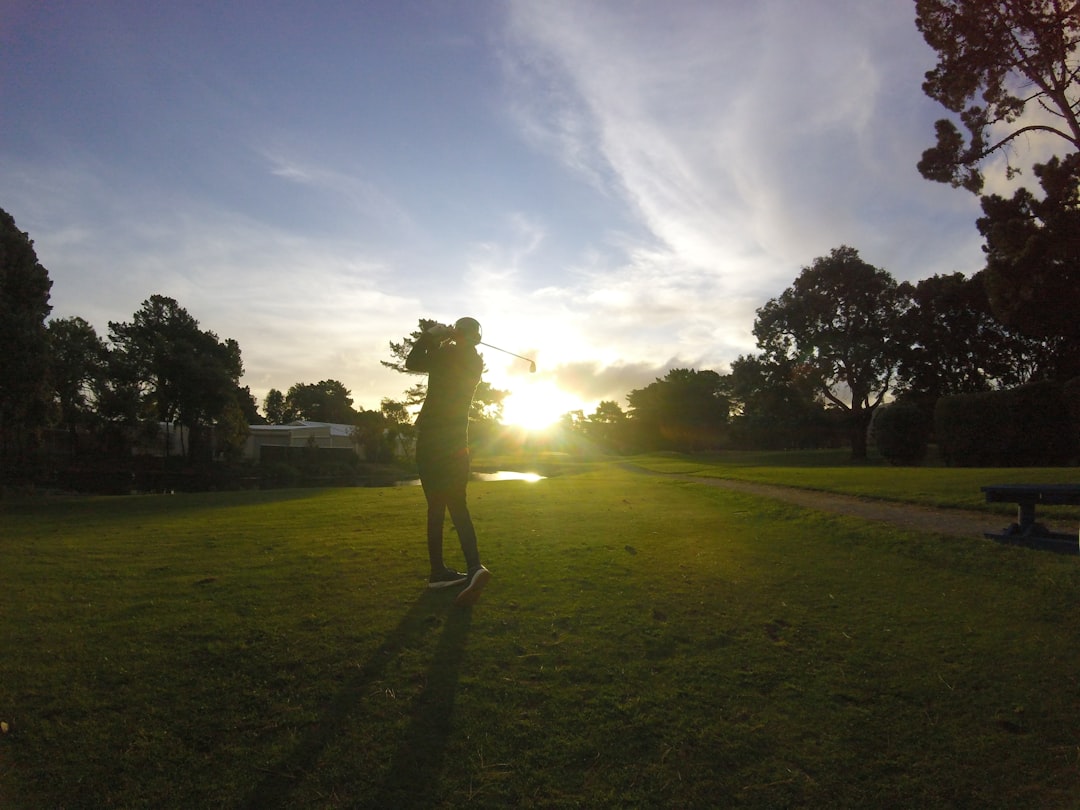
Photo by David Goldsbury on Unsplash
The first thing overthinkers try is the "swing with an empty mind" strategy. It almost never works. "Don't think" is itself a thought — and worse, it adds a new job: monitoring whether you're thinking. It's the classic polar bear problem: told not to think of one, you can't help it.
An empty head, in other words, is not a realistic goal. What is realistic is not erasing thought but giving it somewhere to go.
- Not "think about nothing" but "think about exactly this one thing"
- Not "think whenever" but "thinking ends here" — a boundary drawn in space
The next section turns these two principles into a concrete procedure. And note: a mind that won't switch off shows up beyond the moment of the shot — often as a racing head the night before a round. If that's you, see how to spend the night before a round when you can't sleep.
Decide Where Thoughts Belong: Think Behind the Ball, Hold One Thought at Address
The heart of the fix is deciding in advance where you think and how much. Here's the recommended division.
Behind the Ball = the Thinking Zone
While you're standing behind the ball, think as much as you like. Wind, lie, target, club, today's theme — make every decision here. The corollary rule: never step into address with anything undecided.
Address Through Swing = the Execution Zone
Once you're at address, narrow your awareness to a single thought. And here, cues about the whole motion or the outside world are often said to interfere less than body-part instructions (left arm, wrist angle) — though this doesn't hold for everyone (more on that below). For example:
- "Hold the finish for three seconds"
- "Swing out toward that tree"
- "Same rhythm as the practice swing"
Which cue to use is decided behind the ball as the day's theme — and never changed after address. If doubt creeps in mid-stance, step out and return behind the ball to restart. Re-deciding while standing over the ball produces the worst of both worlds.
A Three-Column Card: Before, Just Before, After
Here is the whole routine on one card. Copy it into a note on your phone and glance at it once before the round.
| While preparing (behind the ball) | Keep just before hitting (after address) | Review after the shot (until the next one) |
|---|
| Decide wind, lie, target, and club | One thought only (e.g., the direction you swing out to) | Did I carry out that one thought? |
| Confirm today's single theme | If doubt creeps in, step back behind the ball | Look for one cause of a miss, not five |
| Run through the checks from your lessons here | Don't add new checkpoints | Note new issues for the next range session |
To copy it as text:
[Preparing] Wind, lie, target, club / today's one theme / lesson checks go here
[Just before] One thought only / step back if in doubt / no new checkpoints
[After] Did I do the one thing? / one cause, not five / note issues for the range
Don't drop checks your coach has given you. Move them to the "preparing" column and handle them during your practice swing instead. Whether a check truly has to stay with you over the ball is a question for the person coaching you.
This think-here, execute-there separation pays off most visibly on the green. Reading the line and then starting to second-guess at address is the classic way putting comes apart — as covered in what to do when tension freezes you over a putt.
The Same Method Doesn't Suit Everyone
The "one thought at address" approach doesn't work the same way at every stage.
- When you're new to the game or rebuilding your swing, the movement isn't settled yet, so you actually need time to check specific body positions. There's no rush to "stop thinking" in this phase
- When you're working on a specific move with a coach, the checkpoints are deliberate. Where you check them should follow the coaching, not your own call
- When your swing is reasonably stable but checkpoints pile up only on the course, this article's method fits best
In other words, what to reduce isn't checking itself — it's the habit of stacking every check into the moment of the swing. If you want to change the shape of your swing, that's beyond this article's scope; work on it as technique, with instruction.
Building the Habit at the Driving Range

Photo by Cristina Glebova on Unsplash
You can't improvise this traffic control on the course — it has to be installed at the range.
The key is splitting practice into "thinking practice" and "execution practice."
- First half (thinking practice): work on your swing mechanics. Film yourself, focus on body parts, hit ball after ball on the same theme. Think all you want here
- Second half (execution practice): for each ball, stand behind it, pick a target, then hit with your awareness narrowed to one thought at address. It's a full dress rehearsal of your on-course procedure
Most golfers spend their entire session on thinking practice — which means thinking mode is the only mode they bring to the course. Mix in the "decide, narrow, swing" drill for even just the last 10 balls, and you'll notice how much quieter your head is when you step into address on the course.
One more thing: adding checkpoints on a bad day tends to backfire. When the misses pile up, that's exactly when to strip back to a single theme. Going home having decided "today was rhythm only" is more than enough.
Test One Kind of Cue at a Time
The "one thing" you keep at address comes in a few kinds. None is better than the others; the goal is to find the one you can use, at the range.
| Kind of cue | Example | How to test it |
|---|
| Image | Picture the ball flight once | Ten balls in a row, seeing only the flight before each |
| Words | A short phrase like "slow back" | Pick one phrase for ten balls; two words max |
| Rhythm | Count "one, two," or match the practice-swing tempo | One practice swing, then straight into the real one, ten times |
| Target | One mark for the direction you swing out to | Change the mark on every ball, ten balls |
Test only one kind per session, and afterward count how many balls you swung without hesitating. Compare by "swung without hesitating," not by how well you struck it. For structuring the whole session, see how to build a golf practice routine.
Connecting Analytical vs. Feel to How You Practice
The Golf Profiler quiz has an "Analytical (T) – Feel (F)" axis. It looks at whether you prefer to build your swing and strategy with reasoning, or to work from images and feel.
That tendency can be a hint for which row of the table above to try first. Analytical golfers, who tend to be good at organizing checks in words, may find it easiest to load up the "preparing" column and keep only a short phrase or a rhythm at address. Feel golfers may find it easier to start with an image or a target.
But the quiz sorts your on-course decision habits from your answers to questions — it doesn't measure your swing. We have no data on which cue works for which type. Use your result only to decide what to try first, and switch if it doesn't fit. For how to adjust your practice approach along each of the four axes, see how to choose a golf practice routine.
Look back at whether analysis or feel comes more naturally to you, and it gets easier to choose where to start in the table. It's 32 questions, about 5 minutes, free, and shows your result without an account.
Frequently Asked Questions
If I focus on only one thing, won't my other flaws show up?
In the short term, sometimes. But compared with trying to honor five checkpoints at once and executing all of them halfway, picking one and trusting your body with the rest tends to preserve better overall balance. Treat the other flaws as future practice themes — one theme per round, one theme per session.
Should I stop thinking about my swing entirely during a round?
No need to stop — just confine it. Think freely while walking or behind the ball; at address, one thought only. And when you spot a swing issue mid-round, don't try to fix it on the spot. Note it down and work on it at your next range session — you'll fix it faster that way.
I'm an overthinker by nature. Is this just unfixable?
The tendency to think before acting is part of your personality, and there's no need to force it out. If anything, thorough pre-shot thinking is a strength — it's preparation. What needs fixing isn't the personality but the timing of the thinking. The think-it-all-through-behind-the-ball procedure suits deliberate thinkers best of all.
Should I cut the checkpoints my coach gave me, too?
Move them rather than cut them. Handle the checks you need during the practice swing or behind the ball, and keep just one at address. Whether a check really has to stay with you over the ball is best asked of your coach. Dropping it on your own can undo a move you're in the middle of fixing.
Knowing my playing partners are waiting makes my mind go even blanker.
That's "I have to hurry" pressure multiplying your thoughts. Here's the thing: deciding behind the ball and then stepping in can be faster overall than standing over the ball and dithering. Separating the deciding spot from the hitting spot doubles as a slow-play remedy.
Summary
- Overthinking mid-swing chops a well-learned motion into awkward fragments
- "Try not to think" backfires. Don't erase thoughts — give them a destination
- Behind the ball is the thinking zone; address onward is the execution zone, with one thought only
- At the range, separate thinking practice from execution practice, and rehearse the full procedure
- Log when your checkpoints multiply, and move checks to the "preparing" column. Keep the ones your coach gave you
- Choose your one cue at address by testing image, words, rhythm, and target one at a time
If the overthinking only happens on the course and never at the range, read what to do when you feel you choke on the course next. If you can't decide which tips to keep, choosing the advice that fits you will help.
When and where your thoughts tend to spiral follows a personal pattern. Take the Golf Profiler quiz (free, about 5 minutes) to see your own decision habits — it makes it easier to decide what goes in the "preparing" column.