A lovely approach leaves you one meter. "This one's in," you think — and the next moment the ball slides past the edge of the cup. Missing a one-meter putt stings precisely because it's so short, and it's hard not to berate yourself: "How does that not go in?"
Worse, once you miss one, the bad memory resurfaces on every short putt that follows, and your hands stop moving freely. Three-putts multiply, and your score falls apart. Sound familiar? You're far from alone.
In this article, we'll look at the psychology that makes the "gimme-length" putt the easiest one to miss, how to avoid unraveling after a miss, and the countermeasures and drills you can start using in your next round.
The Bottom Line: Short Putts Are Missed Less From Technique Than From "I Should Never Miss This"
Let's start with the conclusion. The main reason you miss one-meter putts isn't a flaw in your stroke — it's the tension created by the assumption that this distance should be automatic.
One meter is a distance where the outcome looks binary: make or miss. From five meters, "close is good" feels acceptable; from one meter, success is taken for granted and failure feels embarrassing. Little to gain, much to lose — that's exactly how your brain frames it.
In that state, your body stops trusting its natural stroke and starts trying to avoid a miss. You over-steer the putter head, decelerate through impact, peek the instant you strike it. In other words, the miss usually isn't caused by lack of skill — it's caused by trying too hard to be careful. Which is why the fix centers not on rebuilding your stroke, but on managing the tension and locking down your process.
Why One Meter Is the Most Nerve-Racking Distance
There are several reasons the shortest putts produce the most tension.
Success Gets Defined as "the Default"
Standing over a one-meter putt, most golfers unconsciously raise the standard to "this must go in." The higher the standard, the more vividly you picture the miss first, and the more your body stiffens. In reality, on greens with slope and grain, even pros miss short putts. Simply resetting your standard to "a distance that sometimes misses" takes a full notch off the pressure.
You Think About the Result First
"What if I miss?" "This is for par." The moment you start living in the world after the ball drops, your attention leaves the stroke. And wherever your attention isn't, your body starts making tiny unplanned adjustments. On short putts more than anywhere, you need to bring attention back to the task in front of you: start line and tempo.
The Memory of Past Misses Gets Replayed
Miss one short putt in a big moment, and every similar situation summons the memory. That's not a personal defect — it's a natural response everyone has. We cover how short-putt anxiety forms and how to loosen its grip in a separate article, but the key point is this: don't blame yourself for remembering. You can't erase the memory, but your pre-putt process can change where your attention goes.
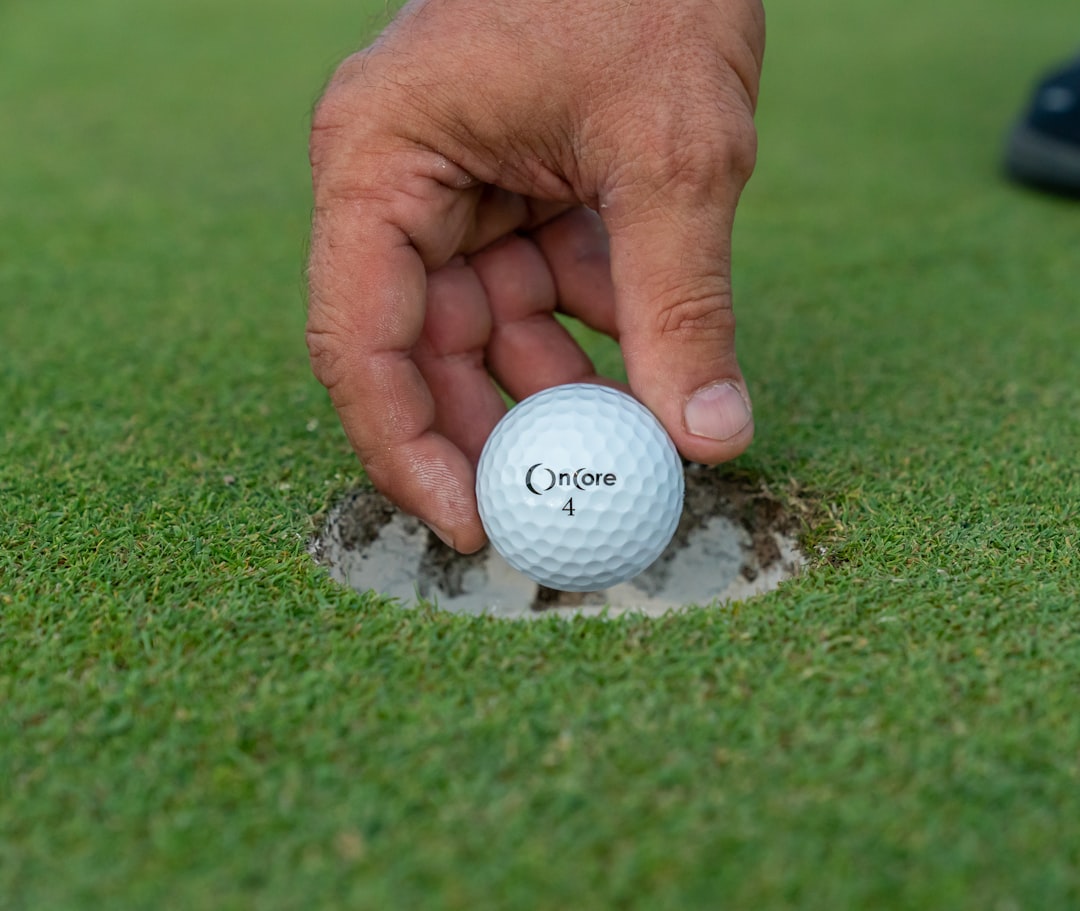
Photo by Peter Drew on Unsplash
Three Fixes You Can Use Next Round
Once you understand the psychology, turn it into behavior. The theme: less time thinking, more process locked in.
1. Make Your Routine Short and Fixed
The shorter the putt, the longer golfers tend to hover over the ball — and hesitation time is tension time. Set a sequence and repeat it identically every time: read the line from behind, one practice stroke, set the putter head behind the ball, start the stroke within two seconds. Routines are widely credited with shifting attention from outcome to process. The contents are up to you; what matters is that it's the same every time.
2. Aim at a Waypoint, Not the Cup
Fixate on the cup and you start steering the ball in. Instead, pick a small waypoint 10 to 20 centimeters in front of the ball's path — an old ball mark, a discolored patch of grass — and make your only task rolling the ball over it at your normal tempo. The binary outcome becomes "did I start it over my spot," a standard entirely within your control, and your body frees up.
3. Decide in Advance What You'll Do After a Miss
Clutch your head or slap the tap-in carelessly, and the bad memory is what sticks. Pre-decide the sequence: miss, one breath, mark the ball, then hit the next one looking only at your waypoint. Having it scripted keeps you from being carried off by in-the-moment emotion. The same principle applies to pressure situations in general — water carries, bunkers, and the rest.
Drills for Home and the Practice Green
For these fixes to hold up on the course, it helps to bank the feeling of holing putts under calm conditions.
At home, the recommended drill on a putting mat is "make them in a row." Around one meter is fine. Set a goal — say, ten in a row — and if you miss, start over from zero. As you approach the end of the streak, a light "don't miss now" pressure kicks in, letting you safely rehearse something close to on-course psychology.
If you have access to a practice green, the classic drill is imagining a one-meter circle around the cup and putting from four directions. Experiencing uphill, downhill, left-to-right, and right-to-left teaches you that one meter is not one putt but four — "this line needs care, this one needs pace" — and that specificity dissolves vague anxiety.
In either drill, don't count misses and sulk. Grade yourself on whether you followed your routine. The habit of evaluating process instead of outcome is what shows up as composure on the course.

Photo by Viktor Ritsvall on Unsplash
Frequently Asked Questions
Why do I pull so many of my short putts?
On short putts, the desperation to make it often leads to manipulating the putter head near impact. Rotate the face closed and you get a pull. Rather than rebuilding the stroke, committing to a waypoint and thinking only about tempo usually reduces the manipulation on its own.
I carry a missed putt with me to the next hole
Deciding your post-miss behavior in advance is the fix. A sequence like "one breath, mark, look only at the waypoint" keeps emotion from taking the wheel. The relationship with mistakes works the same way outside of putting, too. If it still lingers, say your target for the next tee shot out loud between holes — it moves your attention from the past to the next shot.
I make everything in practice and miss only on the course
The difference between practice and the course is whether a miss costs you something. Bring light stakes into home practice — "ten in a row, miss and restart" — and the gap narrows. On the course, also check whether your routine has quietly stretched; under tension, most golfers simply stand over the ball longer.
What if I get so nervous my hands shake?
A light tremor is a natural response everyone experiences, and breathing plus routine settles it in most cases. But if your hands lock up only on short putts, the condition persists for a long time, and practice doesn't improve it, don't carry it alone — consider consulting a teaching professional or an appropriate specialist.
Key Takeaways
- The main cause of missed one-meter putts is tension from "this should be automatic," not technique
- Resetting your standard to "a distance that sometimes misses" lightens the pressure by itself
- On-course fixes: a fixed short routine, a waypoint target, and a pre-decided post-miss script
- At home, bank successes under light pressure with make-them-in-a-row drills
- Grade yourself on process — "did I follow the routine" — not the result
How you unravel over short putts says a lot about your personality and thought patterns. Take the Golf Profiler quiz (free, about 5 minutes) to see how you tend to break down under pressure — it makes it much easier to decide which fix to start with.